
Pre-order now!
Pre-order the new CD from Hogan & Moss
| Track Title [1, 2, 3] | Original Album Source | Highlight Elements |
|---|---|---|
| “Clay Pigeons” | Every Now and Then… (2009) | Haunting, intimate, stripped-down folk minimalism |
| “Leaky Tent” | Reuben’s Train (2014) | Driving, percussive acoustic rhythm guitar chop |
| “Last Kind Words” | You’ve Been That Friend to Me (2015) | Swampy, minor-key delta blues with sharp fiddle |
| “Nothin’” | In the Golden West (2019) | Dark, desolate, apocalyptic desert twang |
PitFork Review
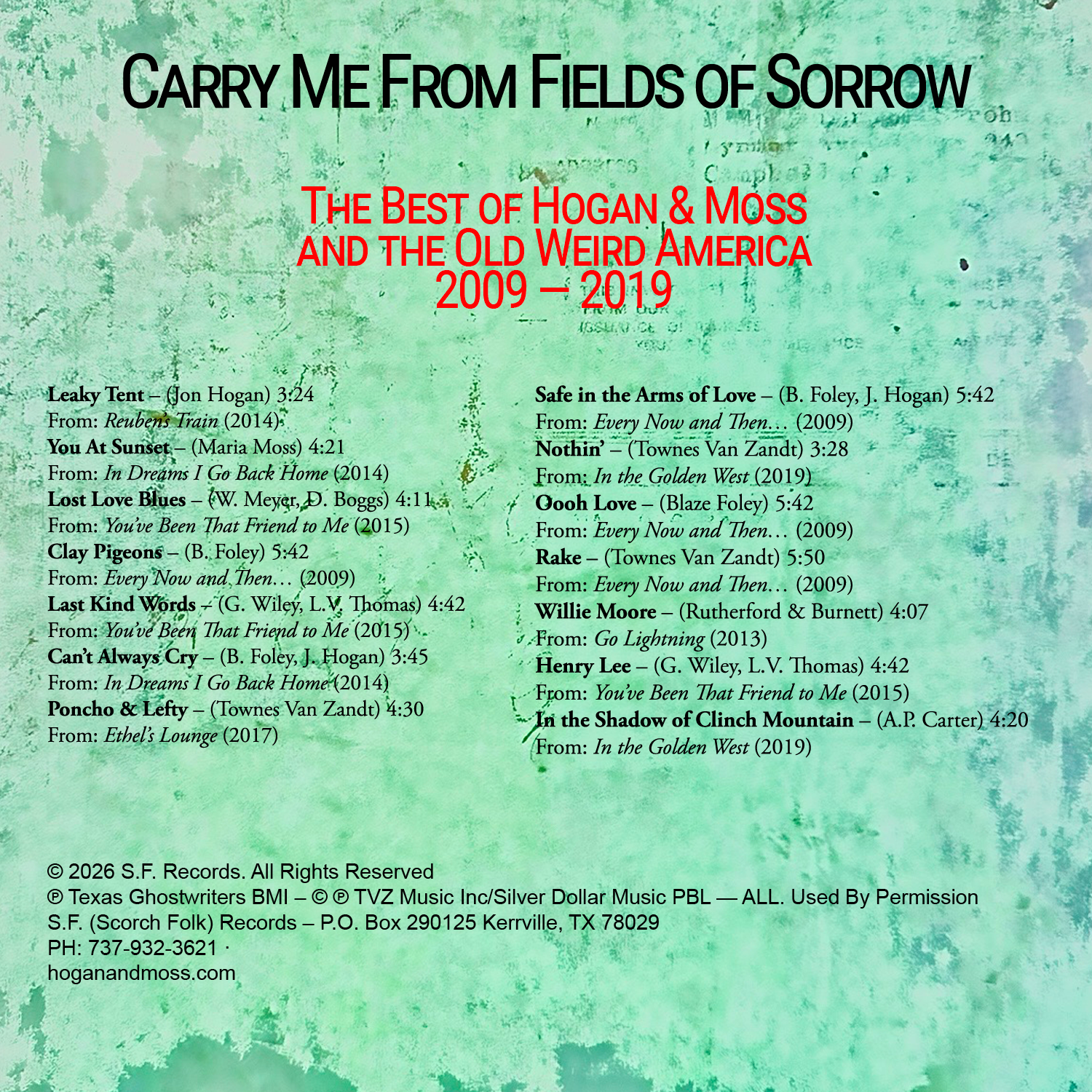
Hogan & Moss and the Old Weird America: Carry Me From Fields of Sorrow – The Best of Hogan & Moss and the Old Weird America 2009 to 2019
8.1
Label: S.F. (Scorch Folk) Records
Reviewed: May 19, 2026 by AL AY Ikline
To borrow a framework from cultural critic Greil Marcus—whose landmark book on Bob Dylan’s Basement Tapes provided this Texas-based duo with their band name—the “Old, Weird America” is not a static point on a map. It is a lawless sonic twilight zone where Appalachian murder ballads, Dust Bowl blues, and outskirt-of-town country cosmicism bleed into one another until the timeline completely collapses. For a generation raised on the pristine, TikTok-optimized gloss of modern country and hyper-processed playlists, staggering into Hogan & Moss’s definitive retrospective, Carry Me From Fields of Sorrow, feels less like visiting a roots-music museum and more like uncovering a box of bootleg VHS tapes hidden deep in the West Texas brush.[1, 2]
Spanning a decade of relentless independent touring and underground grinding across the globe, Carry Me From Fields of Sorrow acts as a beautifully messy, fully analog counterweight to modern corporate music. Releasing via the independent label S.F. (Scorch Folk) Records, Jon Hogan and Maria Moss do not treat tradition like an untouchable oil painting. Instead, they approach the foundational texts of American roots music—the Carter Family, Townes Van Zandt, and Blaze Foley—the way a post-punk band approaches the Stooges: as raw material to be disassembled, customized, and run through a meat grinder of heavy acoustic strumming, slashing strings, and gravel-etched vocals. [1, 2, 3, 4]
Culled from seven different records, the 14 remastered tracks span their self-described genre of “scorch folk”—a chaotic, high-energy style that effectively fuses “Primitive Modernist” mountain traditions with cowpunk energy and desert twang. The retrospective maps out a sonic progression that feels remarkably cohesive despite its sprawling timeline. [1, 2, 3, 4, 5, 6]
The compilation opens with foundational early tracks like their 2009 cover of Blaze Foley’s “Clay Pigeons,” establishing an immediate, striking tension. Jon Hogan sings with a parched, desperate vibrato that sounds as though it has survived several historic droughts and a few poorly lit bar fights. Standing right beside him is Maria Moss, whose virtuosic fingerpicking and clawhammer-adjacent string work do not merely accompany the melodies—they actively haunt them. On their rendition of Townes Van Zandt’s “Rake” (also from 2009), the duo completely reconstructs the song into a trance-like desert ballad, turning Van Zandt’s quiet, poetic stillness into an expansive, cinematic psychodrama. [1, 2, 3]
For a younger listener unburdened by the dogmatic gatekeeping of traditional bluegrass or old-time purism, the most thrilling aspect of this collection is its total lack of reverence for boundaries. It effortlessly bridges the gap between raw minimalist folk and chaotic, fast-paced street energy. On traditional tracks like “Willie Moore” or Geeshie Wiley’s “Last Kind Words,” they unearth the inherent, subterranean darkness of the material. They successfully strip away decades of campfire sentimentality, replacing it with a gothic, ominous minor-key swing that feels strangely modern—occupying the exact same bleak, compelling creative universe as the desolate folk of Zach Bryan or the unpolished early catalog of Adrianne Lenker. [1, 2, 3]
The compilation thrives because it highlights a singular truth about Hogan & Moss: they understand that true folk music is a living, breathing oral history that must evolve to survive. In their hands, an A.P. Carter tune like “In the Shadow of Clinch Mountain” isn’t an artifact to be preserved under glass; it is a vehicle for immediate, visceral emotion. [1, 2]
If there is a flaw to be found across this retrospective, it is the predictable pitfall of any decade-spanning indie compilation: the production values shift wildly across the 14 tracks. Songs captured in makeshift setups or live environments can suffer from a muddy, low-budget mix that occasionally buries Moss’s intricate string arrangements beneath Hogan’s booming rhythm guitar. Yet, in an era where every mainstream release is polished to a sterile, corporate perfection, these minor sonic imperfections function as badges of honor. It is the musical equivalent of film grain or the tracking lines on a degraded tape. [1, 2]
Ultimately, Carry Me From Fields of Sorrow serves as a fascinating entry point into an alternate musical universe. It proves that you don’t need a massive studio budget or a viral internet trend to capture something real. You just need a couple of acoustic instruments, a deep reverence for the weird ghosts of music history, and the willingness to drive down a dark highway until the radio static takes over. [1]